
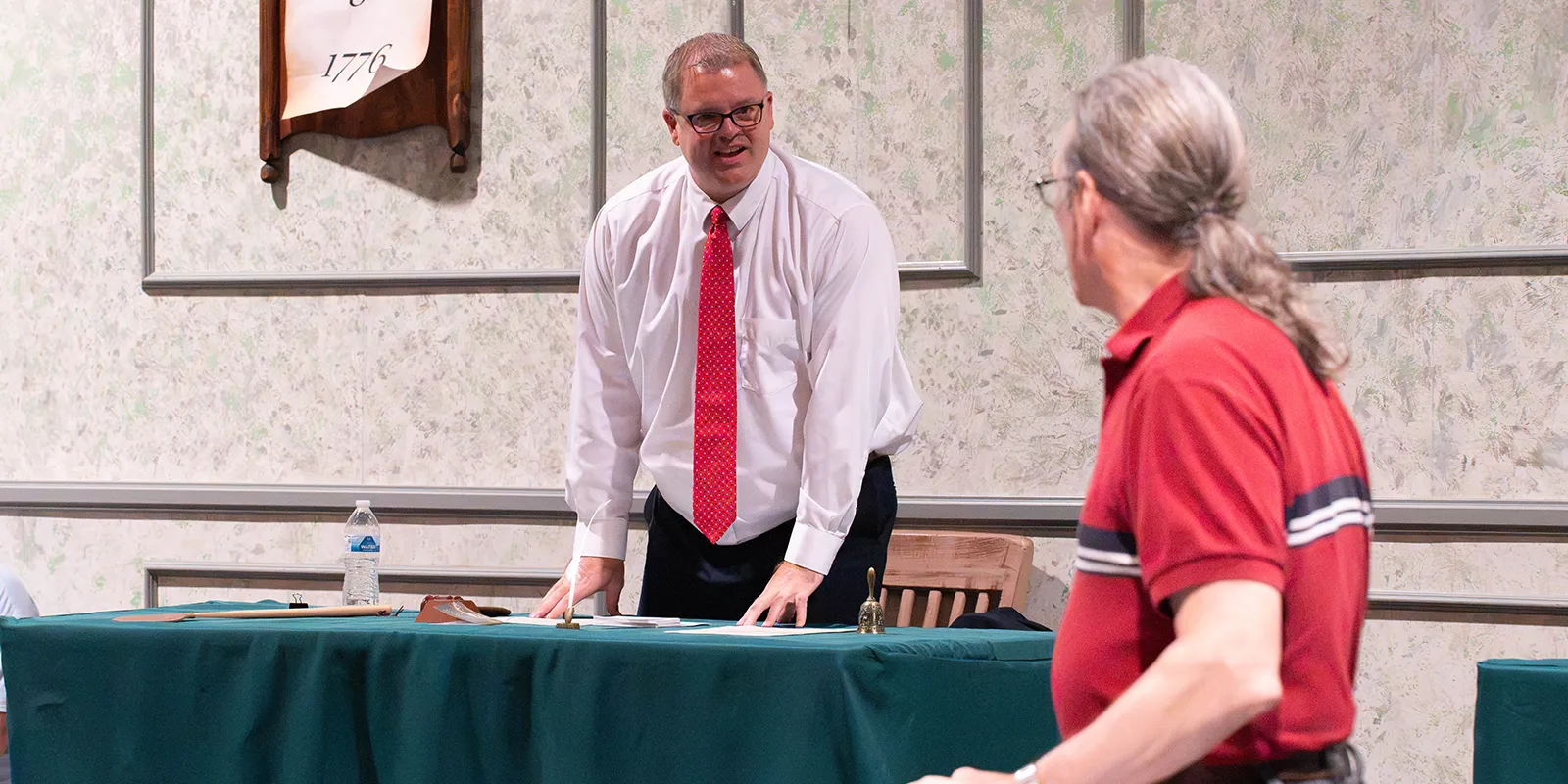
Lee College President Jacob Atkin never expected a simple invitation to support Baytown Little Theater’s production of 1776 would land him in the major role of John Hancock. What began as a one-line cameo quickly became a deep dive into community theater, American history, and a new appreciation for the performing arts.
Several months ago, when discussing logistics for Baytown Little Theater’s use of the Performing Arts Center, Atkin received an unexpected invitation. He was asked if he might be interested in joining the cast of 1776 in a small role of a representative from New Hampshire with a single line.
It sounded manageable, especially for someone with no prior theater experience.
“I have never done theater before,” Atkin said. “Maybe in grade school, but I can’t remember doing anything like this.”
What started as “barely dipping my toe into it,” however, quickly became diving in headfirst.
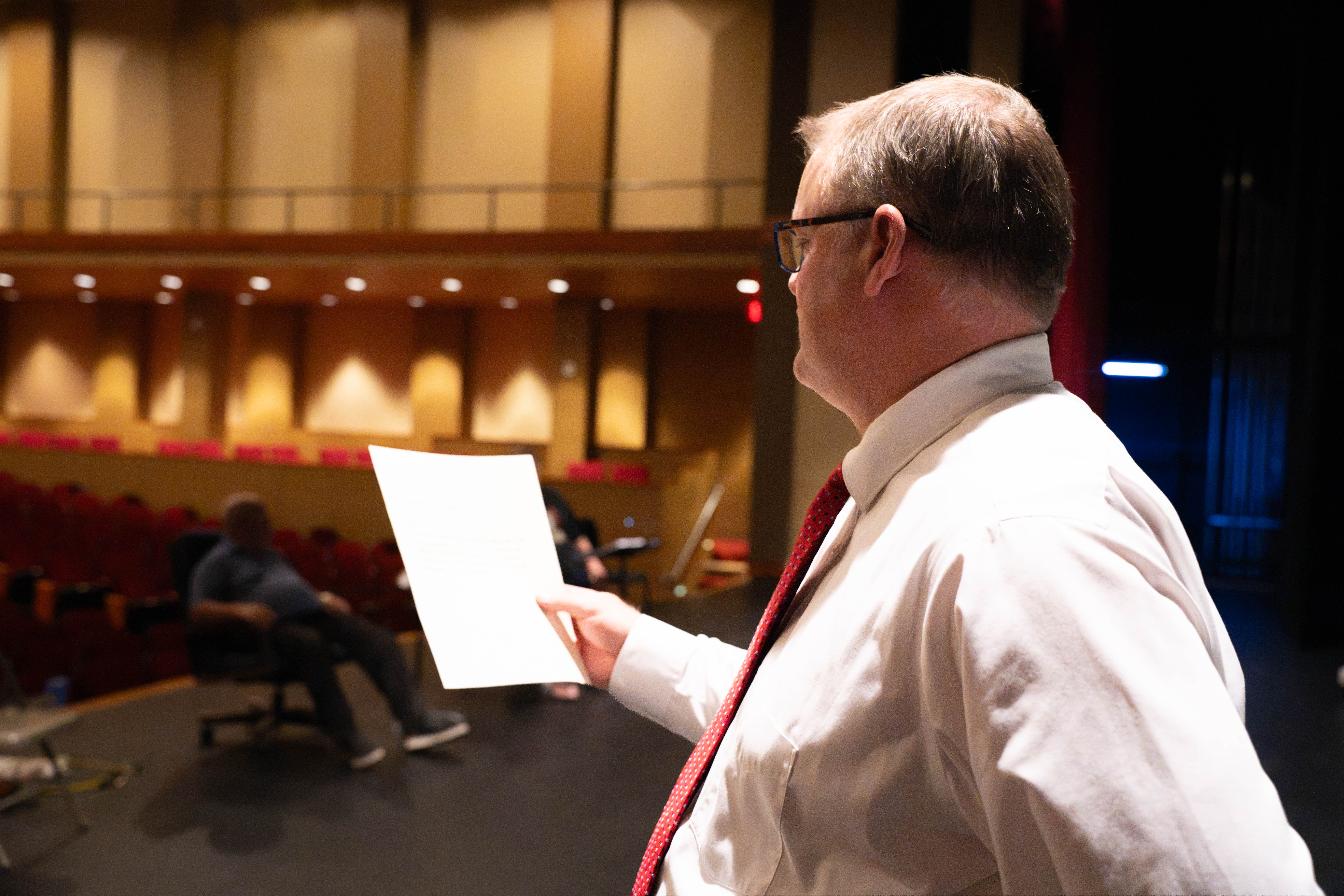 The role evolved from a one-line appearance to a larger supporting character. Then, after auditions, director Jim Wazinski asked Atkin to consider portraying John Hancock, president of the Continental Congress and the first signer of the Declaration of Independence.
That meant more lines, more stage presence, and far more responsibility.
“Once you’re invested, it’s easy to get sucked in farther and farther into the process,” Atkin said with a laugh.
The timing of the show made the experience especially meaningful for Atkin. The production comes as the nation celebrates the 250th anniversary of the signing of the United States Declaration of Independence, a moment he already held in deep regard.
“I love that era of history,” he said. “I honor and respect the men who sacrificed so much to make the United States of America possible.”
Still, taking on a major role in a musical while leading a college is no small undertaking.
Rehearsals take place multiple nights each week, along with weekend stage work and extended Sunday practices. Between leading Lee College and preparing for the performance, Atkin admits his schedule has become intense.
“Mostly I just live on campus now,” he joked.
Yet he sees the commitment as more than personal enrichment.
“This is something I really believe is worth the sacrifice,” he said. “Engaging in the performing arts, supporting a major event here on campus, trying to engage with the community; it’s a lot of what presidents do.”
Rather than simply memorizing lines, Atkin said he has immersed himself in understanding the historical figure he portrays. Studying John Hancock has given him a richer understanding of the person behind one of the most famous signatures in American history.
He describes Hancock as influential, ambitious, charitable, and undeniably proud.
“There was some vanity, a lot of pride, and a lot of courage in how he signed that document,” Atkin said.
That courage becomes even more striking when considering the stakes. Signing the Declaration was not symbolic theater, it was an act of treason against the British Crown, punishable by death.
“If he had ever been captured based on that signature alone, he would have been subject to the death penalty under English law,” Atkin said.
Atkin asks audiences to imagine the conditions of these meetings: a sealed meeting room in Philadelphia during a sweltering summer, no air conditioning, heavy formal clothing, poor sanitation, and mounting political tension. Delegates spent more than a year debating, often bitterly, whether independence was even possible.
“It looked more likely to fail than it ever did to succeed,” he said.
That perspective has changed how he views the founding of the nation.
“I always understood the significance of what they accomplished,” Atkin said, “but maybe not the difficulty in the same way.”
As he reflects on the Continental Congress, Atkin also sees parallels to modern leadership.
The debates of 1776 may seem like something one only reads about in a history book, but the need to navigate disagreement, advocate for ideas, and build consensus feels familiar.
At Lee College, collaboration happens through shared governance, committees, and ongoing dialogue among faculty, staff, and leadership. While today’s meetings are more structured (and thankfully free of chamber pots, as Atkin jokingly noted) the core leadership challenges remain similar.
“The need to argue one’s position, be willing to compromise, and find a mutually acceptable solution, those principles certainly apply in managing a college,” he said.
Beyond the historical lessons, the experience has deepened Atkin’s appreciation for the arts.
That is in part because performing arts can create something traditional classroom learning cannot: emotional connection.
“Getting a well-rounded education is about more than facts and figures,” he said.
Music, movement, storytelling, and live performance create experiences that stay with people long after lectures and exams are forgotten. For students, those experiences can be transformative.
Atkin believes college should be more than earning credits or completing coursework.
“This is meant to be more than two additional years of education after high school,” he said. “It’s an experience. It’s a transformative process.”
That philosophy is one reason he sees such value in the arts, not just for performers, but for everyone involved, from stage crew and sound technicians to ticket sellers and audience members.
Participation, he says, strengthens both individuals and communities.
What surprises him most about performing arts is not simply the memorization, but the extraordinary complexity behind every scene.
“Memorizing your lines is like one-third of it,” he said. “But there’s also the timing, the movement, the singing, the cues. It’s so intricate.”
From the audience, much of that work is invisible. When a production runs smoothly, viewers see only the finished magic.
As opening night approaches, Atkin hopes audiences leave with more than appreciation for a well-executed musical. Far more than that, he hopes they walk away with a deeper understanding of the sacrifices that shaped the nation and a renewed appreciation for the freedoms Americans have inherited.
“We have inherited a tremendous gift from those who came before us,” he said. “It’s our obligation to appreciate it and pass it forward to the next generation.”
For Atkin, stepping onto the stage has become about more than performing. It is about history, community, courage, and the willingness to step beyond comfort.
His advice to anyone considering theater or any creative pursuit is simple.
“Dare to try new things,” he said. “Be brave enough to put yourself in a position to be criticized, and the enjoy the benefits of all the lessons you learn in that process.”
Opening night of 1776 is July 24, and the production runs through Aug. 2 at the Lee College Performing Arts Center. Tickets are available online at https://www.lee.edu/pac/.